Fred Espenak, popularly known as “Mr Eclipse”, is a retired emeritus American astrophysicist known for his work on eclipse predictions.
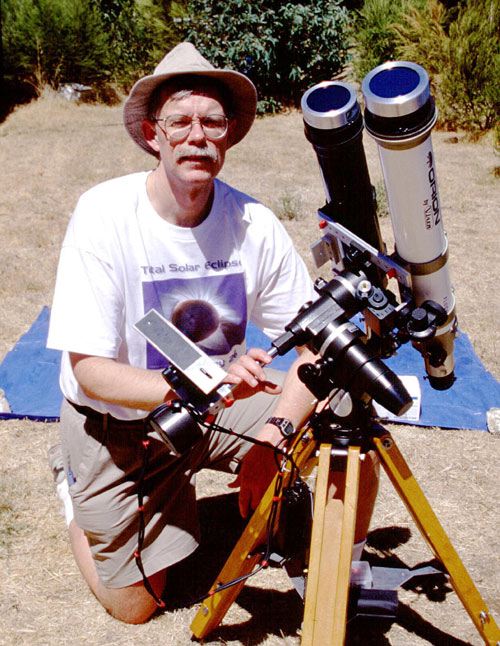
He became interested in astronomy when he was 7–8 years old, and had his first telescope when he was around 9–10 years old. After earning a degree in physics from Wagner College, Staten Island, he worked in the planetarium there. After getting his master’s at the University of Toledo, he worked at Goddard Space Flight Center, where he used infrared spectrometers to measure the atmospheres of planets in the Solar System.
The first solar eclipse he saw was on March 7, 1970, sparking an interest leading to his observation of over 20 eclipses since then, including some in Antarctica. One of Espenak’s notable achievements is his creation of the NASA Eclipse Bulletins, comprehensive publications providing detailed information and predictions for upcoming eclipses. These bulletins became indispensable resources for researchers, educators, and eclipse enthusiasts around the world. Espenak’s expertise and dedication to accuracy made him a trusted authority on eclipse predictions and led to the adoption of his “Mr Eclipse” moniker.
Beyond his work at NASA, Espenak is renowned for his captivating eclipse photography. His stunning images have graced numerous publications like National Geographic, Newsweek, Nature, New Scientist, and Ciel et Espace magazines. The publication of his photos in books, magazines, and websites allows people worldwide to appreciate the awe-inspiring beauty of eclipses. Espenak’s photographs not only capture the visual spectacle of these events but also convey the emotional impact they evoke.
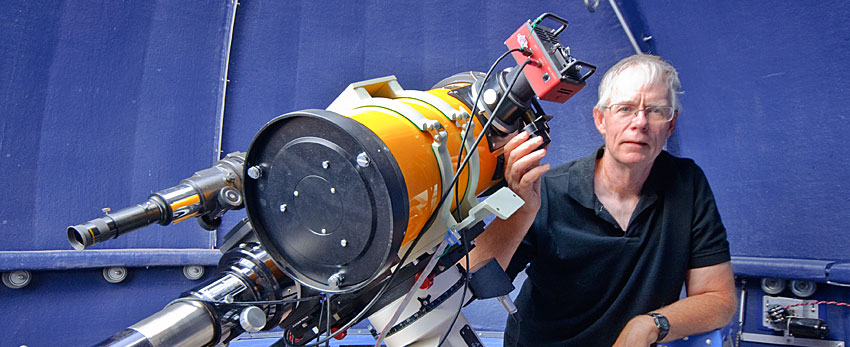
He published several books, including:
- Five Millennium Canon of Lunar/Solar Eclipses (the latter with Jean Meeus) in 2006/2009, respectively. These books cover all types of lunar/solar eclipses (partial, total, annular, or hybrid for solar and penumbral, partial or total for lunar) from 2000 BCE to AD 3000.
- Thousand Year Canon of Luna/Solar Eclipses 1501 to 2500
- 21st Century Canon of Solar Eclipses.
- Totality: Eclipses of the Sun, co-authored with Mark Littmann and Ken Willcox.
In 2003, the International Astronomical Union honored him for his work on eclipses by naming an asteroid Espenak. He retired in 2009 & spends most clear nights losing sleep and photographing the stars.
Further reading
Espenak F.(2023), Mr. Eclipse, (Accessed: 30th June 2023)
Garner R.(2009), NASA’s ‘Mr. Eclipse’ Retires but Still Chasing Shadow, (Accessed: 30th June 2023)
Fred Espenak, The World At Night, (Accessed: 30thJune 2023)
Dr Fred Espenak (2009), Goddard Researcher and eclipse chaser Dr. Fred Espenak, (Accessed: 30th June 2023)
Dr. Fred Espenak, Public Lectures and Speaking Engagements (2017), Fred Espenak, (Accessed: 30th June 2023)
Dr Fred Espenak (2006), FIVE MILLENNIUM CANON OF SOLAR ECLIPSES: -1999 TO +3000, NASA, (Accessed: 30th June 2023), Retrieved 17 January 2020.
Dr Fred Espenak (2009), FIVE MILLENNIUM CANON OF LUNAR ECLIPSES: -1999 TO +3000,NASA, (Accessed: 30th June 2023), Retrieved 17 January 2020.
Dr Fred Espenak (2014), Thousand Year Canon of Lunar Eclipses 1501 to 2500,(Accessed: 30th June 2023) Retrieved 17 January 2020.
Dr Fred Espenak (2014), Thousand Year Canon of Solar Eclipses 1501 to 2500, (Accessed: 30th June 2023) Retrieved 17 January 2020.
Dr Fred Espenak (2014), 21st Century Canon of Solar Eclipses, (Accessed: 30th June 2023) Retrieved 17 January 2020.


